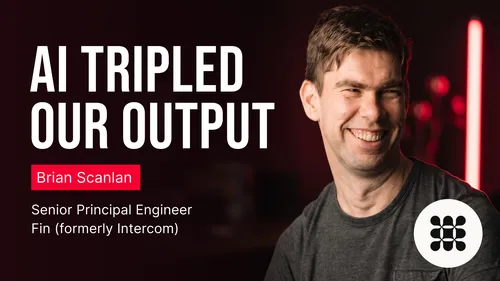
How Fin Tripled Engineering Output With AI38:44
BUILDINGFILM

How Fin Tripled Engineering Output With AI

Brian Scanlan, Senior Principal Engineer at Fin (formerly Intercom), says AI tripled the changes the company ships in 12–18 months. He explains the company-wide push behind that jump in AI developer productivity, and why people there are happier, too.

Nov 19, 2026 38:44

Brian Scanlan

Expert Insights

Brian Scanlan has spent 12 years in the platform group at Fin. He frames AI developer productivity as a company-wide change: he starts with the goal and culture, then the teams and tools that support them. In his account, throughput tripled, and people are happier.

Hear him outline:

    • A public goal to double throughput in 12 months, measured in pull requests, led to a dedicated 2x team and one shared agent platform, Claude Code.

    • People are happier because they feel less blocked, and they take on areas like design and product with more confidence.

    • Fin puts its money in a human team "supercharged" with AI tokens, instead of chasing the cheapest token.

    • Adoption comes from writing the expectation into level guides and rewarding progress with promotions and spot bonuses.

    • Quality is tracked by a Stanford research group, and it turned the corner about six months ago after an early dip.

    • Fin's next experiment is knowledge wikis and graphs that could let agents take part in planning.

You are way better off having a team of humans that you're investing in who are supercharged with these AI tokens.
— Brian Scanlan, Senior Principal Engineer at Fin (formerly Intercom)

Monterail Team Analysis

    • Set one goal for the whole company and give it a dedicated team. Fin measured pull requests, which Brian calls imperfect but closer to output than counting tokens, and staffed the team with senior engineers.

    • Pair a clear expectation with rewards. Fin told everyone to do it, wrote the expectation into level guides for engineers, designers and product managers, then added promotions and spot bonuses.

    • Track how people feel along with how fast they ship. Brian reports that people feel less blocked and take on more.

    • Choose one agent platform and set it up centrally. Fin pushed identical settings to every laptop and sent telemetry to Honeycomb.

    • Bring in outside measurement. Fin's Stanford research group first saw quality falling, then rising, so expect a dip before the gains.

    • Compare spend to the cost of a change and the quality of the result. Brian calls chasing the cheapest model or self-hosting graphics processing units (GPUs) a distraction.